

The Arab states of the Persian Gulf have entered a period of great turmoil.
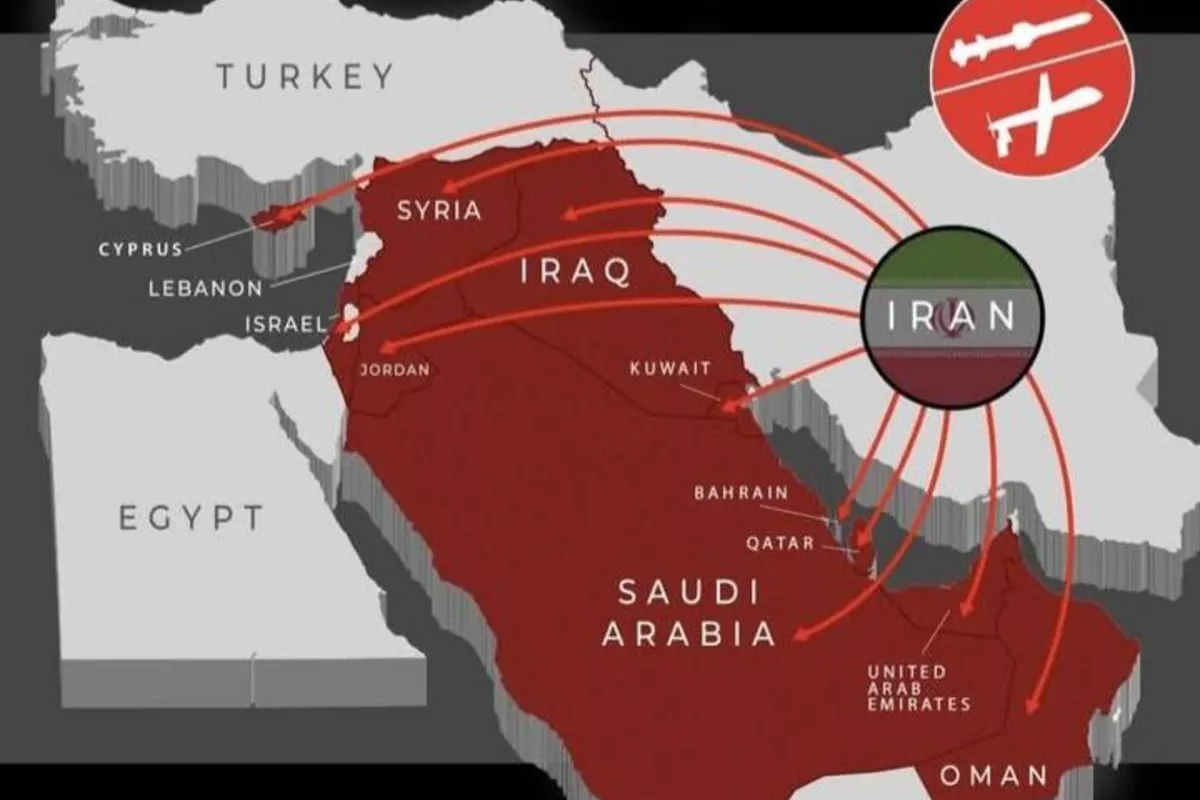
The United States and Israel took a risk by launching a surprise attack on Iran on February 28 of the current year.
To the extent that they had been informed in advance, America’s allies in the Arab Gulf states did the same. And they lost.
No obvious political or military objectives were achieved by those who started the war, neither regime change in Iran, nor neutralization of its missile capabilities, nor control of the Strait of Hormuz.
On the contrary, the anti-Iran bloc was forced to seek a ceasefire that gave the latter full control of the strategically critical Straits, paralyzing the regional and global economy, blocking the passage of energy on which their functioning depends, and keeping its army intact, operationally ready and with unwavering determination capable of inflicting devastating blows on its enemies.
The shift in the balance of power
The 40-day war between the US, Israel, Arab states alliance and Iran revealed a reality that many find difficult to accept: The ability of the United States to project military power in the Middle East has weakened to the point of near complete ineffectiveness.
At the same time, the original US-oriented security architecture that existed for decades failed to prevent Iran from effectively consolidating control over energy hubs that the United States was supposed to control.
The new security system
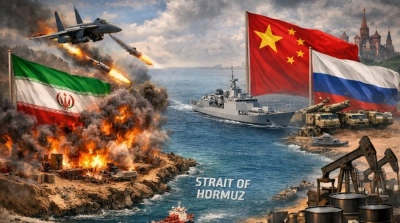
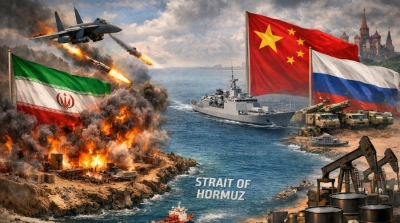
This new reality forces the region and the world to abandon perceptions based on the assumption of US military deterrence capability and to turn to a multipolar security system arising from economic reality, which will include relations with Russia, China and the countries of BRICS.
The outdated military doctrine on which the old security relationship was based is no longer viable, and any attempt to revive it would be excessively costly and ultimately unworkable.
In short, the US lost because its core approach to regional problems, based on military power, ceased to be effective, and no increase in defense spending can change that.
This is an extremely unpleasant surprise for countries such as the Arab states of the Persian Gulf and India, which have based their strategy on the logic of US military superiority.
Now, these countries warn the world about the weakening of the rule of law due to the loss of control of the Strait of Hormuz, noting that there are many similar “strategic points” that could be put at risk, leading to broader conflicts and disruption of globalization.
These leaders now promote the idea that peace depends on shared prosperity, pipelines, trade and sustainable economic networks, not on military occupation or escalation.
But this is precisely the policy that Iran has been following for decades, while being rejected by its Arab neighbors, who felt safe only under the US military “umbrella”, which proved to be an illusion.
The blockage of oil flows
For the Arab Gulf states, the reality is that the Strait of Hormuz is essentially closed, and previous assumptions that it would automatically open with the help of the US navy no longer apply.
Although the region’s energy-producing countries are seeking alternatives, such as increasing the use of East–West pipelines in Saudi Arabia or strengthening facilities in Yambor and Fujairah, the reality is that most of the energy capacity remains trapped in the Persian Gulf and cannot reach markets.
Even if the war ended today, it would take months for the Strait of Hormuz to reopen and for infrastructure to be restored.
The absolute defeat
However, the arrogance of the Arab Gulf states remains evident.
They argue that they do not need to compromise with Iran and expect its “goodwill” in order to address the problems.
They appear to ignore their long history of cooperation with the US and Israel against Iran, including providing infrastructure and territory for military and intelligence operations that made the February 28 attack possible.
In reality, the Arab states of the Persian Gulf have lost all the strategic positions they had before the war.
Instead of seeking a return to the past, they must, if they want to survive the crisis, recognize the strategic defeat of the pro-US alliance and the enduring importance of the Islamic Republic in the region.
To achieve this, they must abandon the mindset dominated by the security doctrine linked to the US and accept a new reality in which Russia, China and eastern powers are taken into account.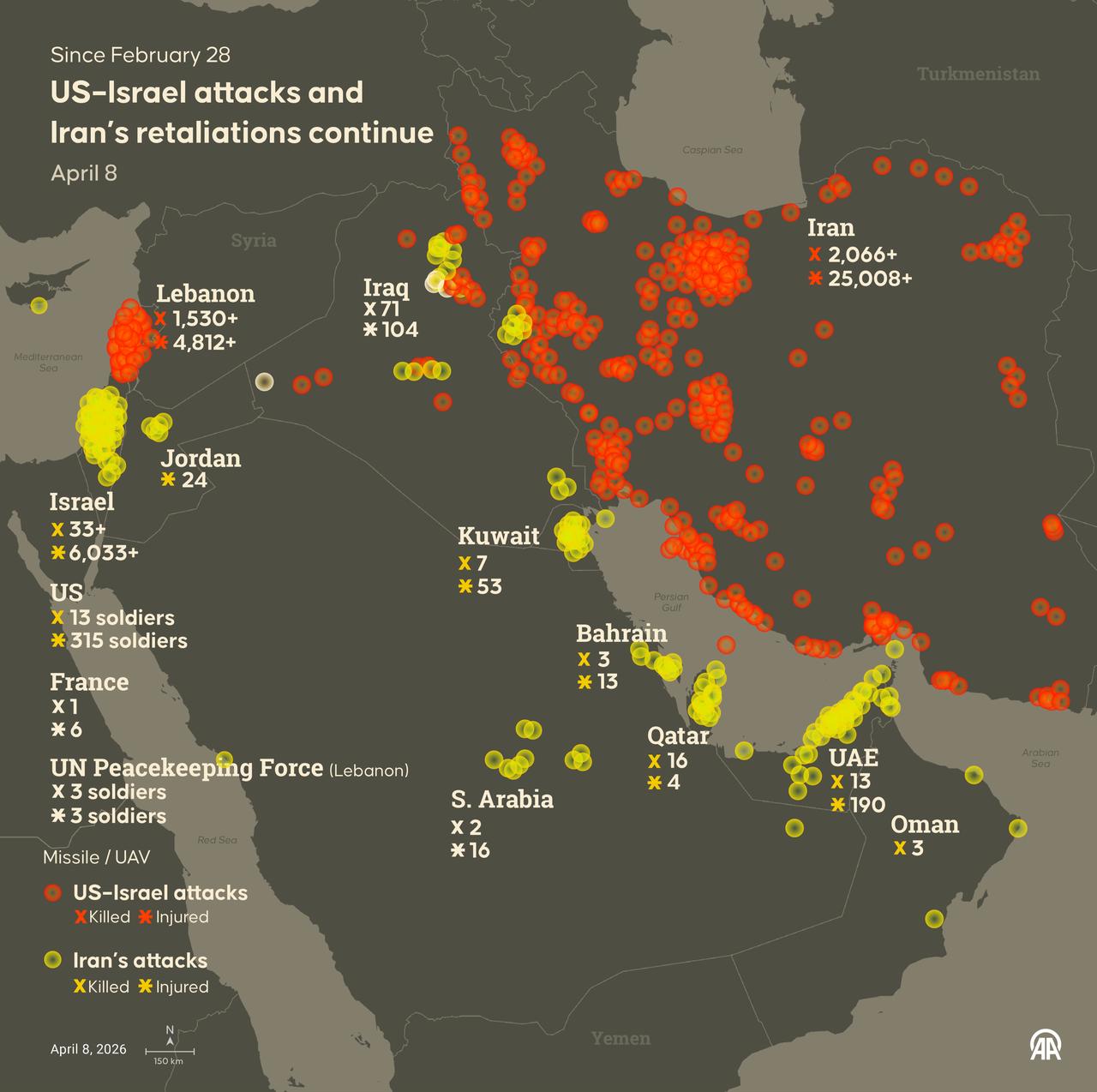
The destruction of energy infrastructure
In simple terms, a new war is not an option for the Persian Gulf states, they would not survive such a development.
The Iranian government has already recorded the energy infrastructure that would be targeted in the event of a new attack.
If Iran implements its threats, and experience shows that it does, the Gulf states will suffer irreparable damage to their energy and economic base.
Diplomacy is the only path left.
There is no military solution.
The cost of $58 billion for infrastructure
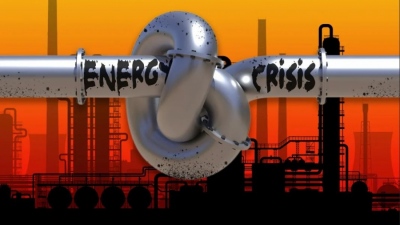
The war in the Middle East will have lasting effects on the energy market, as the cost of destroyed infrastructure begins to be calculated at enormous levels.
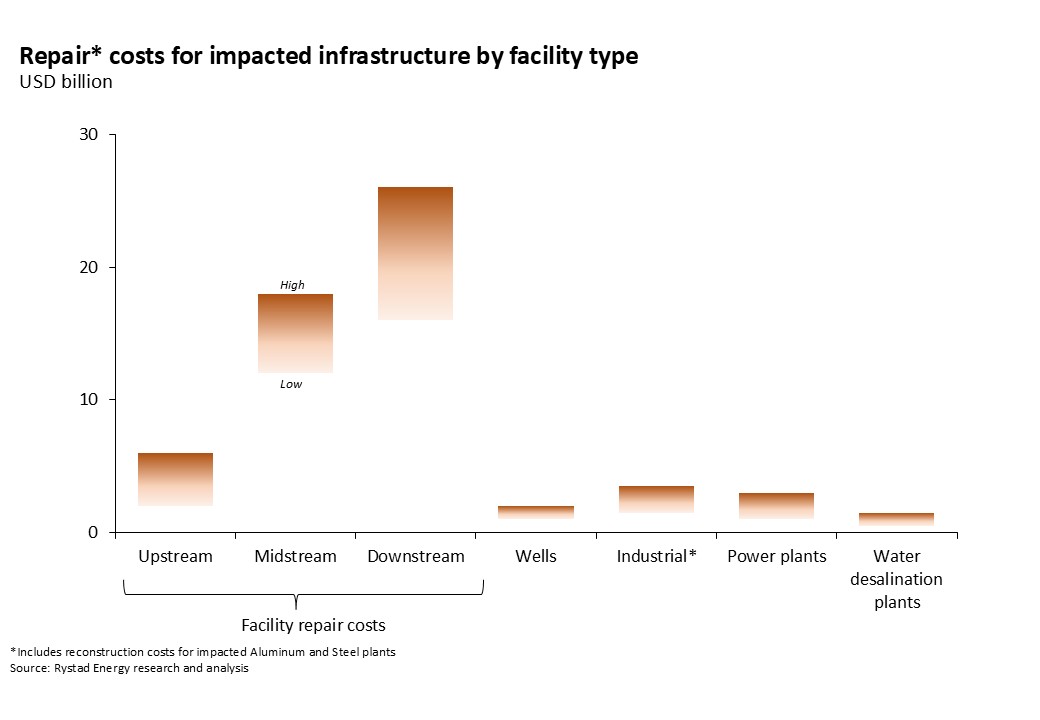
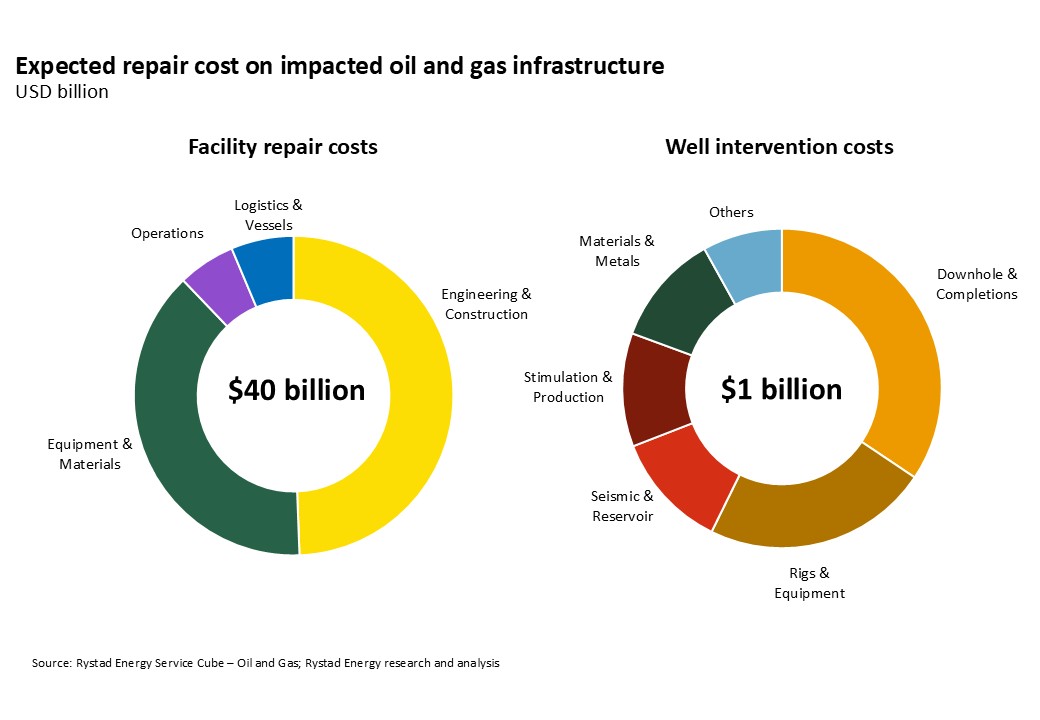
The cost of repairing and restoring energy infrastructure due to the war in the Middle East could reach $58 billion, according to an analysis by Rystad Energy, with the total for oil and gas facilities potentially reaching $50 billion.
This is no longer just a matter of damaged installations in the Gulf.
It is a stress test for the global energy supply chain, the company notes in its analysis.
The same equipment and the same contractors required for reconstruction are already committed to a wave of LNG projects and offshore investments approved since 2023.
Repairs do not create new production capacity, they redirect existing capacity, and this will be felt in project delays and inflationary pressures far beyond the Middle East.
Massive secondary effects as well
The $58 billion is the headline, but the secondary effects on global energy investment timelines may prove equally significant.
Karan Satwani, senior supply chain analyst at Rystad Energy, notes that just weeks after the initial estimate of $25 billion, the scale of the damage has increased significantly.
The continuation of military strikes increased the number of affected installations before the situation stabilized somewhat after the April 8 ceasefire between the US and Iran.
Thus, the average estimate of total recovery costs now stands at $46 billion (range $34–58 billion), of which about $5 billion concerns industrial, energy and desalination units.
The fragile ceasefire, delayed negotiations and the risk of renewed escalation continue to affect the environment, along with the risk of disruptions to navigation through the Strait of Hormuz.
The demand for US withdrawal
And given that all the “cards” are now in the hands of Iran despite statements by Trump, the Gulf states must understand that any solution will have to take into account Iran’s demands for the withdrawal of US military forces from the region.
Ultimately, in the Middle East of the future, all involved must recognize that the US is part of the problem and not the solution, and any country that continues to rely on it will face only disappointment.
Today, a new paradigm of balance of power operates in the Middle East.
And it does not include the United States.
www.bankingnews.gr






Σχόλια αναγνωστών